

Chris Bumstead Workout Routine: A Comprehensive Guide
Discover the ultimate guide to replicating Chris Bumstead’s physique! Explore detailed workout plans, access downloadable PDFs, and uncover the secrets to his success.
Chris Bumstead, a dominant force in the classic physique division, has captivated the fitness world with his aesthetic build and dedication. His training isn’t about chasing fleeting trends; it’s a meticulously crafted approach centered around building a balanced, proportional, and visually striking physique.
CBUM’s philosophy emphasizes a blend of heavy compound lifts, strategic isolation work, and a deep understanding of progressive overload. He prioritizes feeling the muscle contract – the mind-muscle connection – over simply lifting the heaviest weight possible. Many resources, including downloadable PDFs, detail his approach. These guides often break down his workout splits, exercise selections, and rep schemes.
His success isn’t solely attributed to genetics; it’s a testament to consistent hard work, intelligent programming, and a commitment to refining his technique. Understanding this foundation is crucial before diving into any CBUM-inspired workout routine.
Understanding the CBUM Workout Approach
Chris Bumstead’s workout approach isn’t a rigid, one-size-fits-all program. It’s a framework built on core principles adaptable to individual experience levels. PDF guides and online resources reveal a focus on periodization, varying volume and intensity throughout the year. His routines often shift between phases emphasizing hypertrophy, strength, and peaking for competition.
A key element is the Push-Pull-Legs (PPL) split, frequently utilized but customized to address his specific needs. These downloadable resources highlight the importance of exercise selection, favoring movements that maximize muscle fiber recruitment. CBUM doesn’t shy away from traditional bodybuilding exercises, but emphasizes proper form and controlled execution.
Ultimately, the CBUM approach is about intelligent training, not just blindly following a program. It requires self-awareness, listening to your body, and making adjustments as needed.
The Core Principles of the CBUM Routine
CBUM’s success stems from compound lifts, progressive overload, and a strong mind-muscle connection, all detailed in available workout PDF guides and resources.
Focus on Compound Lifts
Chris Bumstead’s workout routine heavily emphasizes compound lifts as the foundation for building overall strength and muscle mass. These exercises, such as squats, deadlifts, bench presses, and overhead presses, engage multiple muscle groups simultaneously, maximizing efficiency and stimulating greater hormonal responses. PDF guides detailing his programs consistently prioritize these movements.
Unlike isolation exercises, compound lifts allow for heavier loads, promoting significant strength gains and muscle hypertrophy. Bumstead’s approach isn’t about chasing the pump with endless isolation work; it’s about building a solid base of strength through fundamental movements. Resources and downloadable workout PDFs showcase his preference for these exercises, often forming the core of his push, pull, and leg days. This focus is crucial for achieving his aesthetic physique.
Prioritizing Progressive Overload
Central to the Chris Bumstead workout philosophy, and clearly outlined in available PDF guides, is the principle of progressive overload. This means consistently increasing the demands placed on your muscles over time to stimulate continued growth. Bumstead doesn’t rely on static routines; he continually challenges himself.
Progressive overload can be achieved through various methods – increasing weight, reps, sets, or decreasing rest times. His programs, often found in downloadable PDF formats, demonstrate a systematic approach to adding weight each week, even if it’s just a small increment. This consistent progression is key to breaking plateaus and achieving long-term muscle development. The emphasis isn’t on ego lifting, but on sustainable, measurable improvements.
Importance of Mind-Muscle Connection
Chris Bumstead’s success isn’t solely about lifting heavy weights; a crucial element, detailed within his workout PDF guides, is the mind-muscle connection. This involves consciously focusing on contracting and controlling the targeted muscle throughout each repetition. It’s about feeling the muscle work, not just moving the weight.
The PDF resources emphasize slowing down the eccentric (lowering) phase of each exercise to maximize muscle fiber recruitment and tension. Bumstead advocates for visualizing the muscle contracting and squeezing at the peak of the movement. This intentional focus enhances muscle activation and improves overall workout effectiveness. Ignoring this connection can lead to inefficient training and limited gains, hindering progress towards the CBUM physique.
Chris Bumstead’s Workout Split
Unlock Chris Bumstead’s physique with his proven workout split, readily available in comprehensive PDF guides! Target muscle groups efficiently for optimal growth.
Push Day: Detailed Breakdown
Maximize chest, shoulder, and triceps development with a CBUM-inspired Push Day! PDF guides detail exercises like incline dumbbell press, flat barbell bench press, and cable flyes for chest.
Shoulder work includes seated dumbbell presses, lateral raises, and front raises, building broad, sculpted deltoids. Triceps are targeted with close-grip bench presses, overhead extensions, and pushdowns.
Sets and reps vary, often utilizing a 3-4 set range with 8-12 repetitions, emphasizing controlled movements and peak contraction. Progressive overload is key, consistently increasing weight or reps. Downloadable resources provide specific workout structures and demonstrate proper form, ensuring effective and safe training. Focus on mind-muscle connection for superior results!
Chest Exercises
CBUM’s chest workouts prioritize building a full, defined pectoral region. PDF guides highlight key exercises like incline dumbbell press, targeting the upper chest for a complete look. Flat barbell bench press forms the foundation, building overall mass and strength.
Cable flyes are crucial for shaping and isolating the chest muscles, enhancing definition. Decline dumbbell presses add lower chest development. Sets typically range from 3-4, with 8-12 repetitions, focusing on controlled eccentric contractions.
Progressive overload is essential – gradually increase weight or reps. Proper form is paramount to prevent injury and maximize muscle activation. Downloadable resources demonstrate correct technique and provide workout variations.
Shoulder Exercises
Chris Bumstead’s shoulder routine focuses on building broad, sculpted deltoids. PDF workout guides emphasize a balance of anterior, medial, and posterior shoulder development. Overhead press, both barbell and dumbbell variations, are foundational for overall shoulder mass.
Lateral raises are key for widening the shoulders, creating a V-taper. Front raises target the anterior deltoids, contributing to a fuller look. Rear delt flyes, using dumbbells or a machine, are crucial for balanced shoulder development and posture.
Typically, sets range from 3-4 with 10-15 repetitions, prioritizing controlled movements. Progressive overload and proper form are vital for maximizing results and preventing injury. Resources often include detailed exercise demonstrations.
Triceps Exercises
Chris Bumstead’s triceps work is designed to add detail and size to the arms, complementing his overall physique. Workout PDFs highlight exercises that effectively target all three heads of the triceps muscle. Close-grip bench press is a staple, providing a compound movement for overall triceps activation.
Overhead triceps extensions, utilizing dumbbells or cables, isolate the long head, contributing to arm length. Pushdowns, with various attachments like rope or V-bar, focus on the lateral and medial heads. Skullcrushers, performed with barbells or EZ-curl bars, are included for advanced lifters.
Sets generally fall within the 3-4 range, with 8-12 repetitions, emphasizing controlled eccentric contractions. Proper form and progressive overload are essential for maximizing growth and minimizing risk of injury.
Pull Day: Detailed Breakdown
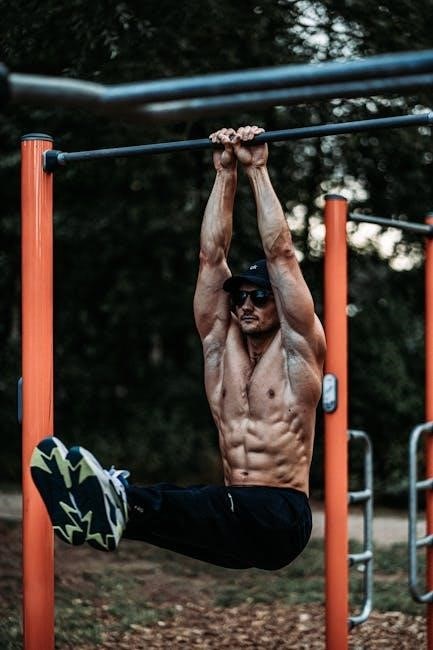
Chris Bumstead’s pull day, as detailed in available workout PDFs, focuses on building a wide and thick back, alongside well-developed biceps and rear deltoids. The emphasis is on compound movements to maximize muscle fiber recruitment. Pull-ups, often weighted, are a cornerstone, building overall back strength and width.
Barbell rows, both bent-over and seated cable rows, target the back’s thickness. Lat pulldowns, with varying grips, further contribute to width. Face pulls are incorporated to improve shoulder health and rear delt development. Bicep curls and hammer curls round out the session.
Typically, CBUM utilizes 3-4 sets of 8-12 repetitions, prioritizing controlled movements and a strong mind-muscle connection.
Back Exercises
Chris Bumstead’s back workouts, outlined in various PDFs, prioritize building both width and thickness. Bent-over barbell rows are a staple, performed with a focus on controlled form and a full range of motion. Seated cable rows are also frequently included, allowing for consistent tension throughout the set.
Pull-ups, often weighted to increase intensity, are a cornerstone exercise for developing upper back strength and width. Lat pulldowns, utilizing different grip variations, further target the lats. T-bar rows are sometimes incorporated for added thickness.
Sets generally range from 3-4, with repetitions falling between 8-12, emphasizing a strong mind-muscle connection.
Biceps Exercises
Chris Bumstead’s biceps training, detailed in available workout PDFs, focuses on achieving peak and overall mass. Barbell curls are a foundational exercise, performed with strict form to isolate the biceps. Dumbbell curls, including variations like hammer curls and concentration curls, are also prominent.
Cable curls provide constant tension throughout the range of motion, enhancing muscle activation. Preacher curls are utilized to further isolate the biceps and minimize momentum. Sets typically range from 3-4, with repetitions generally between 10-15.
CBUM emphasizes controlled movements and a strong mind-muscle connection during each repetition, prioritizing quality over quantity.
Rear Deltoid Exercises
Chris Bumstead’s rear deltoid work, as outlined in workout PDFs, is crucial for shoulder width and balanced development. Face pulls are a cornerstone, executed with a rope attachment to maximize muscle activation and improve posture. Bent-over dumbbell rear delt flyes are also frequently included, demanding controlled movements.

Reverse pec deck flyes offer a machine-based option for targeted isolation. Cable pull-throughs, though often considered a hamstring exercise, contribute to rear delt engagement. Sets generally fall between 3-4, with repetitions typically in the 12-15 range.
CBUM stresses focusing on squeezing the rear deltoids at the peak contraction for optimal results.
Leg Day: Detailed Breakdown
Chris Bumstead’s leg day, detailed in available workout PDFs, prioritizes overall leg mass and shape. Squats are foundational, often barbell back squats, performed for 3-4 sets of 8-12 repetitions. Leg press variations, including single-leg presses, are incorporated for volume.
Romanian deadlifts (RDLs) target the hamstrings and glutes, typically 4 sets of 10-15 reps. Leg extensions and hamstring curls isolate the quads and hamstrings, respectively. Walking lunges add functional strength and address muscle imbalances.
CBUM emphasizes controlled movements and a full range of motion, focusing on feeling the muscle work throughout each exercise.
Quadriceps Exercises
Chris Bumstead’s quadriceps training, as outlined in workout PDFs, centers around building substantial leg mass; Barbell back squats are a cornerstone, typically performed for 3-4 sets of 8-12 repetitions, emphasizing depth and control. Front squats are also utilized to target the quads with a different stimulus.
Leg press variations, including both standard and single-leg presses, provide additional volume and allow for focused muscle activation. Leg extensions are incorporated as an isolation exercise, usually for 3-4 sets of 12-15 reps.
CBUM prioritizes a full range of motion and a strong mind-muscle connection during each set.
Hamstring Exercises
Chris Bumstead’s hamstring routine, detailed in available workout PDFs, focuses on developing balanced leg musculature. Romanian deadlifts (RDLs) are a primary exercise, performed for 3-4 sets of 8-12 repetitions, emphasizing a controlled eccentric phase and full stretch. Conventional deadlifts are also included, though less frequently than RDLs.
Lying leg curls are a staple isolation exercise, typically executed for 3-4 sets of 12-15 reps, focusing on peak contraction. Seated leg curls offer a variation to target different hamstring fibers.
Good mornings are occasionally incorporated to further challenge the hamstrings and lower back, always prioritizing proper form.
Calf Exercises
Chris Bumstead’s calf training, as outlined in various workout PDFs, prioritizes both volume and range of motion for complete development. Standing calf raises are a foundational exercise, performed for 4-5 sets of 15-20 repetitions, ensuring a full stretch at the bottom and a strong contraction at the top.
Seated calf raises are included to target the soleus muscle, typically executed for 3-4 sets of 15-20 reps. Donkey calf raises, though less common, are sometimes utilized for a unique stimulus.
Variations in foot placement – inward, outward, and straight – are employed to target different aspects of the calf muscles.
Sample Weekly Workout Schedule
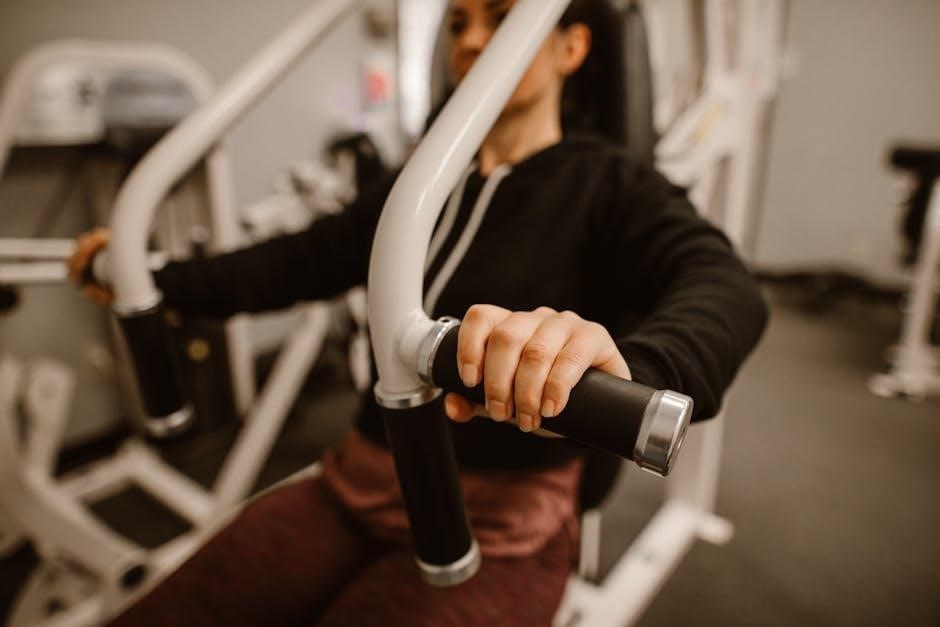
Follow a structured plan: Monday ー Push, Tuesday ー Pull, Wednesday ⎻ Legs, Thursday ー Rest, Friday ⎻ Push (Volume), Saturday ー Legs (Hamstring/Glute focus).
Monday: Push
Begin your week with a dedicated Push day, focusing on chest, shoulders, and triceps. Start with incline dumbbell press, 4 sets of 8-12 reps, followed by flat barbell bench press, also 4 sets of 8-12 reps. Incorporate dumbbell flyes for chest isolation, 3 sets of 10-15 reps;
Transition to shoulder work with seated dumbbell shoulder press, 4 sets of 8-12 reps, and lateral raises, 3 sets of 12-15 reps. Finish with triceps exercises like close-grip bench press, 3 sets of 8-12 reps, and overhead dumbbell extensions, 3 sets of 10-15 reps. Remember to prioritize proper form and controlled movements throughout each exercise. Focus on feeling the muscle contraction for optimal results, mirroring Chris Bumstead’s mind-muscle connection approach.
Tuesday: Pull
Dedicate Tuesday to a comprehensive Pull workout, targeting back, biceps, and rear deltoids. Initiate with pull-ups (or lat pulldowns if needed), aiming for 4 sets to failure. Follow with barbell rows, 4 sets of 8-12 reps, and seated cable rows, 3 sets of 10-15 reps, to build back thickness.
Shift focus to biceps with barbell curls, 3 sets of 8-12 reps, and hammer curls, 3 sets of 10-15 reps. Don’t neglect rear deltoids; incorporate face pulls, 3 sets of 15-20 reps, and reverse flyes, 3 sets of 12-15 reps. Maintain strict form and concentrate on squeezing the muscles during each repetition. Emulate CBUM’s emphasis on controlled movements for maximum muscle activation and growth.
Wednesday: Legs
Prioritize leg day with a focus on quadriceps, hamstrings, and calves. Begin with barbell back squats, performing 4 sets of 6-10 reps, ensuring proper form and depth. Incorporate leg press, 3 sets of 10-15 reps, and leg extensions, 3 sets of 12-15 reps, to further isolate the quads.
Transition to hamstrings with Romanian deadlifts, 4 sets of 8-12 reps, and lying leg curls, 3 sets of 10-15 reps. Finish with standing calf raises, 4 sets of 15-20 reps, and seated calf raises, 3 sets of 15-20 reps. Remember to control the eccentric phase of each exercise for optimal muscle damage and growth, mirroring Chris Bumstead’s approach.
Thursday: Rest or Active Recovery
Embrace recovery as a crucial component of the CBUM routine. Opt for complete rest to allow muscles to repair and rebuild, or engage in active recovery to promote blood flow and reduce soreness. Consider light cardio, such as walking or cycling, for 20-30 minutes at a low intensity.
Incorporate foam rolling and stretching to improve flexibility and address muscle imbalances. Prioritize hydration and nutrition to support the recovery process. Avoid strenuous activity that could hinder muscle recovery. Remember, adequate rest is essential for maximizing gains and preventing overtraining, aligning with Chris Bumstead’s dedication to holistic fitness.
Friday: Push (Volume Focus)
Dedicate this day to maximizing muscle hypertrophy through increased volume for pushing movements. Perform a higher number of sets and reps compared to the Monday push workout, focusing on controlled contractions and proper form. Include exercises like incline dumbbell press, flat barbell press, and cable flyes for chest.
Target shoulders with lateral raises, front raises, and overhead press. Finish with triceps extensions and close-grip bench press. Prioritize maintaining intensity throughout the workout, even with the increased volume. Remember to listen to your body and adjust the weight accordingly, mirroring CBUM’s approach to pushing limits safely.
Saturday: Legs (Hamstring/Glute Focus)
Shift the leg day emphasis to hamstring and glute development, crucial for a balanced physique. Incorporate exercises like Romanian deadlifts, hamstring curls (lying and seated), and glute bridges with added weight. Perform hip thrusts, focusing on a full range of motion and peak contraction.
Include variations like single-leg Romanian deadlifts to address muscle imbalances. Add glute-focused accessory work, such as cable kickbacks and banded walks. Maintain a controlled tempo and prioritize feeling the muscle work. Remember, CBUM emphasizes building a strong posterior chain for overall leg development and aesthetic appeal.
Sunday: Rest
Prioritize complete rest and recovery on Sundays, a non-negotiable component of the CBUM routine. Allow your muscles to repair and rebuild after a demanding week of training. Engage in light activities like walking or stretching if desired, but avoid strenuous exercise.
Focus on optimizing sleep, aiming for 7-9 hours of quality rest. Ensure adequate hydration and maintain a nutritious diet to support recovery. Remember, rest is not laziness; it’s a vital part of the muscle-building process. CBUM understands the importance of allowing the body to fully recover to prevent overtraining and maximize results.

Chris Bumstead’s Diet & Nutrition
Fuel your physique like a pro! Discover CBUM’s macronutrient breakdown, learn his supplementation strategy, and understand the vital role of hydration for optimal gains.
Macronutrient Breakdown
Understanding Chris Bumstead’s dietary approach is crucial for mirroring his physique. While specific numbers fluctuate based on training phases, a general macronutrient breakdown provides valuable insight. Typically, CBUM prioritizes a high-protein intake, essential for muscle repair and growth, often falling within the range of 1.0-1.2 grams of protein per pound of bodyweight.
Carbohydrates serve as the primary energy source, strategically adjusted based on activity levels, generally comprising around 40-50% of his total caloric intake. Healthy fats, vital for hormonal balance and overall health, constitute the remaining 20-30%. This isn’t a rigid structure, but a flexible framework allowing for adjustments based on individual needs and progress. Accessing detailed guides, often available as PDFs, can provide more precise breakdowns tailored to different goals.
Supplementation Strategy
Chris Bumstead’s supplementation isn’t about magic pills, but strategically supporting a solid diet and training regimen. Key supplements often include creatine monohydrate, enhancing strength and muscle volume, and whey protein, for convenient protein intake post-workout. BCAAs (Branched-Chain Amino Acids) are utilized to aid muscle recovery and reduce soreness.
Furthermore, he incorporates vitamins and minerals to address potential deficiencies and optimize overall health. Pre-workout supplements are occasionally used for an energy boost, but aren’t a staple. Detailed workout PDFs sometimes outline his preferred brands and dosages, though individual needs vary. Remember, supplements complement, not replace, a well-structured diet and consistent training.
Importance of Hydration
Hydration is a cornerstone of Chris Bumstead’s approach, often understated but critically important for performance and recovery. Adequate water intake supports muscle function, nutrient transport, and overall metabolic processes. Dehydration can significantly hinder training intensity and impede muscle growth.
CBUM emphasizes consistent sipping throughout the day, not just during workouts. Electrolytes are also considered, particularly during intense training or in warmer climates, to replenish those lost through sweat. Workout PDFs often don’t explicitly detail water intake, but implicitly support it through emphasis on volume and recovery. Prioritizing hydration is a simple yet powerful strategy for maximizing results.
Accessing the CBUM Workout PDF & Resources
Find premium workout guides on platforms like Amazon Kindle. Explore free resources and connect with online communities for CBUM-inspired training plans!
Official CBUM Workout Guides
For those seeking a structured and in-depth approach, official Chris Bumstead workout guides are readily available. Currently, a 20-premium workout guide is offered as a Kindle edition through Amazon, authored by Dymanite Fitness.
This comprehensive resource delves deep into CBUM’s training methodologies, covering every major muscle group – chest, back, legs, shoulders, biceps, and triceps – with detailed exercise breakdowns. The guide highlights Chris’s favorite exercises and those he prioritizes within his routine. It provides a direct pathway to understanding and implementing the techniques that have contributed to his championship-winning physique. These guides represent a curated and authentic representation of his training philosophy, offering a valuable asset for dedicated fitness enthusiasts.
Free Resources & Online Communities
Beyond paid guides, numerous free resources and vibrant online communities cater to fans of the CBUM workout approach. Various websites, like The Fitness Phantom, offer summaries and interpretations of his routines, often including downloadable PDF outlines of his Push, Pull, Legs (PPL) split.
These resources, while not official, provide a starting point for understanding his training principles. Engaging with online fitness communities – forums, social media groups – allows for shared experiences, advice, and motivation. However, remember to critically evaluate information from unofficial sources and prioritize safety. Utilizing these platforms can supplement your knowledge and provide support on your fitness journey, fostering a collaborative learning environment.